



TL;DR: Stuff You Should Know Before You Buy A 510 Thread Battery
- 510 thread batteries share the same physical connection standard, but they are far from identical
- Voltage output, battery capacity, activation type, and build quality vary massively across price points
- Most 510 carts and batteries are compatible — but proprietary systems like PAX Era, JUUL, and Stiiizy pods are not
- Voltage matters more than brand: wrong voltage = burnt oil, wasted carts, bad hits
- Variable voltage + preheat is the spec combo that covers 90% of use cases
- Budget $20–50 for a daily driver; anything less locks you into fixed voltage that shortchanges your oil
- TL;DR: Stuff You Should Know Before You Buy A 510 Thread Battery
- What Is a 510 Thread Battery?
- Are 510 Thread Batteries Universal?
- Are All 510 Cartridges Compatible?
- How Do You Choose the Right 510 Thread Battery?
- How Much Should a 510 Battery Cost?
- How to Choose the Right 510 Thread Battery: Quick Decision Framework
- Maintaining Your 510 Battery: The Basics That Most People Skip
- Wrapping Up
- FAQ: 510 Thread Batteries
I remember the first time someone handed me a 510 cartridge and a random battery and said, “just screw it on.” It worked. Sort of. The cart barely fired, the hit was weak and tasteless, and I thought cannabis oil vaping was genuinely terrible.
It wasn’t the oil. It was the battery.
That was my introduction to one of the most misunderstood pieces of kit in vaping. The 510 thread connection has been the industry standard for over a decade, and yes — almost everything fits everything else.
But fit and performance are two very different things. I’ve tested hundreds of these batteries across nicotine vaping, CBD, THC oil, and THCA carts, and what I’ve learned could genuinely save you money, cartridges, and a lot of frustration.
Let’s get into it.
What Is a 510 Thread Battery?
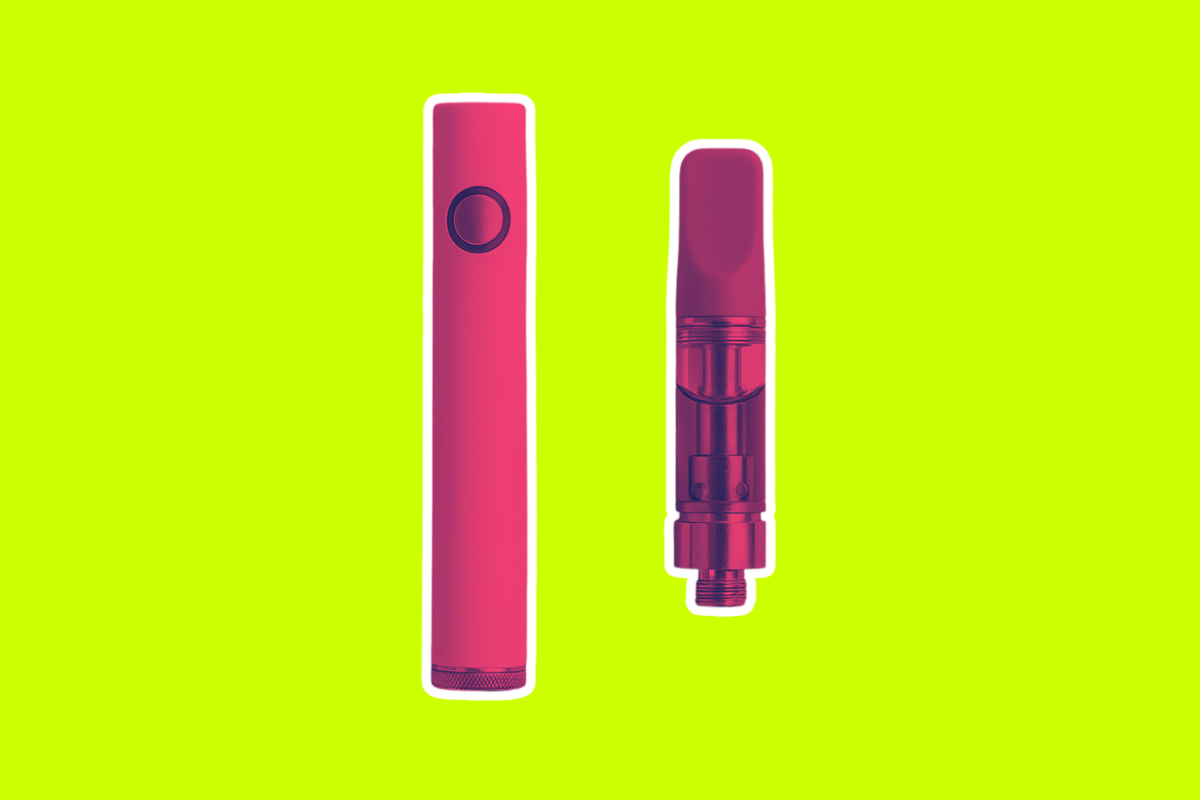
A 510 thread battery is a compact rechargeable power source designed to connect to vape cartridges using a standardised threading system. The name comes from the specification itself: 10 threads, each spaced 0.5mm apart.
That specific thread pattern became an industry standard years ago, originally in the nicotine vaping world, and it has since migrated to cannabis oil, CBD, THCA, and wax concentrate setups.
Today when most people say “510 battery,” they mean a cart battery — a small, portable device you screw a pre-filled oil cartridge onto and vape.
Despite being called a “battery,” most 510 devices are complete vaping units.
They contain a lithium-ion cell, a circuit board with safety protections, button or draw-activation electronics, and sometimes voltage control, LED displays, and preheat functions — all inside a body small enough to disappear into your pocket.
The connection is simple. The variation underneath it is not.
Fun Fact: The 510 threading standard was originally popularised by early nicotine e-cigarette manufacturers. Back then, the spec literally described the connector: 10 threads at 0.5mm spacing. Today, not every 510 connection even has 10 threads anymore — but the name stuck, and it remains the universal shorthand for the dominant cartridge connection format in the vaping industry.
Are 510 Thread Batteries Universal?
Mostly yes — but “universal” needs some unpacking.
The physical 510 thread connection is standardised enough that the vast majority of cartridges and batteries from different brands will screw together.
You can take a cannabis oil cart from one dispensary, a CBD cart from an online retailer, and screw both onto the same battery without any issue.
That cross-compatibility is genuinely useful and one of the main reasons the format has dominated for so long.
However, “screws on” and “works well” are not the same thing.
Here is where it gets more complicated:
- Voltage matters more than the thread. A fixed-voltage battery running at 3.8V will burn a thin CBD oil that should be vaped at 2.4V. The threads fit. The experience will be harsh, burnt, and wasteful. The cart may never fully recover.
- Manufacturing tolerances vary. Some cartridges sit slightly deeper on certain batteries, which can cause short-circuit-adjacent contact issues or a wobbly, unreliable connection. It is uncommon, but it happens — especially with cheaper, unbranded carts.
- Proprietary systems exist. This is the big exception. PAX Era pods, JUUL, original Stiiizy pods — these use entirely different connections. They are not 510. No adapter will fix this, regardless of what certain sellers claim. If you buy one of these systems, you are locked into their battery ecosystem entirely.
For 95% of standard 510 cartridges, any 510 battery will physically connect. Whether it powers that cart well depends on voltage range, output consistency, and whether it supports your oil’s viscosity. That is the real compatibility question.
Are All 510 Cartridges Compatible?
With each other and with standard batteries — largely yes. With every battery on the market, not always.
Standard 510 cartridges share the same thread spec, so the physical connection is consistent.
Where compatibility breaks down is at the electrical level.
Two scenarios cause real problems:
- Coil resistance vs battery output. Most oil cartridges run coils in the 1.0–2.0 ohm range. Standard 510 batteries are designed for exactly this. But some wax atomiser attachments, which also use 510 threading, run much lower resistance coils that need significantly more power. Using a basic cart battery with a wax atomiser will often result in weak, unsatisfying vapour or no vapour at all.
- Proprietary proprietary proprietary. Worth repeating: some brands have built their own pod systems with custom connections that look different from 510 threading. If you are buying carts at a dispensary, always check the connection type before assuming your existing battery will work.
For everything that uses genuine 510 threading — distillate carts, live resin carts, CBD oil carts, THCA carts, nicotine oil carts — compatibility is essentially universal. Plug it in, dial in your voltage, and you are good to go.
How Do You Choose the Right 510 Thread Battery?
This is the question I wish more people asked before they bought. Here is how I think about it:
Match voltage range to your oil type

This is the single most important factor.
Oil viscosity and chemical composition directly affect the optimal temperature for vaporisation.
Getting this wrong burns terpenes, wastes oil, and makes your cart taste awful.
As a starting framework:
- CBD oils and thin concentrates: 2.0–2.8V. Low and slow preserves terpenes and flavour. This is also where most nicotine oil carts perform best.
- Standard THC distillate and all-purpose carts: 2.8–3.3V. This covers the majority of what you will find on dispensary shelves.
- Live resin and live rosin: 2.5–3.0V maximum. These are terpene-rich and will taste burnt above 3.0V. Treat them like CBD oil — go lower.
- Thick, high-potency distillates: Up to 3.8–4.0V, but only if the oil genuinely needs it. Use preheat first before cranking voltage.
Always start at the lowest setting and work up. You can always increase. You cannot un-burn terpenes.
Button-activated vs draw-activated
Draw-activated (auto-draw) batteries fire when you inhale. No button. Simple, intuitive, beginner-friendly. The downside is you have less control over draw length, and some auto-draw sensors can misfire or fail over time.
Button-activated batteries give you precise control over exactly when and how long the battery fires. I prefer button-activated for daily use because of the added control — but for casual use or sharing, auto-draw is genuinely more convenient.
Battery capacity
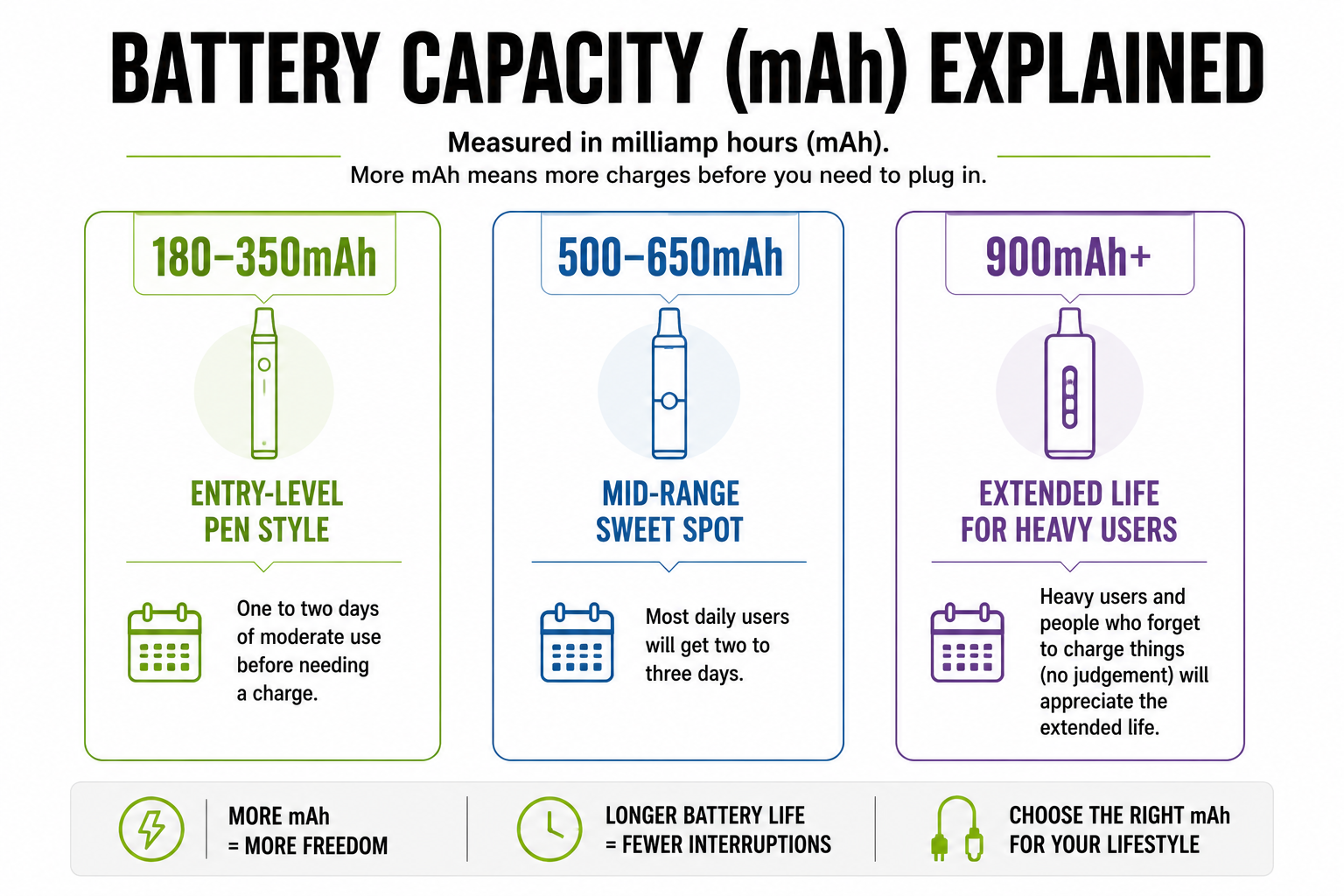
Measured in milliamp hours (mAh). More mAh means more charges before you need to plug in.
- 180–350mAh: Entry-level pen style. One to two days of moderate use before needing a charge.
- 500–650mAh: Mid-range sweet spot. Most daily users will get two to three days.
- 900mAh+: Heavy users and people who forget to charge things (no judgement) will appreciate the extended life.
Preheat function
This is non-negotiable for thick oils.
Preheat runs the battery at low power for 8–15 seconds before your first hit, warming the oil without vaporising it.
This prevents clogs, improves the first pull, and extends cartridge life considerably — especially with live resin, delta-8, and high-potency distillates in cold weather.
If you use thick oils at all, get a battery with preheat.
Form factor
- Pen style: Slim, discreet, pocket-friendly. The classic shape. Works everywhere.
- Palm style: Wider, ergonomic, sits in the hand rather than between the fingers. Brands like CCELL have made this popular.
- Box mod / box style: More power, more features, sometimes with OLED displays. Bulkier but excellent for people who want precise control.
- Concealed style: The battery is designed to look like a standard disposable vape. The cartridge loads inside a shell that hides it completely. Useful if discretion matters to you.
How Much Should a 510 Battery Cost?
Here is the honest breakdown by price tier:
Under $20 — Entry Level
You are looking at simple pen-style or auto-draw batteries from brands like Yocan, Ooze, and similar. Capacities typically land between 180mAh and 350mAh. Most run fixed voltage around 3.6V, which is too hot for a lot of oils. Build quality is plastic-heavy.
The key point here: a $15 Yocan or CCELL battery at this price point will massively outperform a $15 no-name generic. Brand reputation is your quality signal when shopping at the bottom of the market. Established brands use proper short-circuit protection, over-discharge protection, and consistent threading that will not strip.
This tier works for beginners, backup batteries, and occasional users. It is not where I would start for daily use with quality oils.
$20–$50 — Mid-Range
This is where I tell most people to shop. At this price point you get variable voltage, preheat functions, metal casing (usually aluminium alloy), USB-C charging, and battery capacity in the 500–900mAh range. Brands like Yocan Uni, CCELL M3B Plus, Vessel Compass, and Ooze Slim Twist Pro all live here.
Variable voltage at this price tier changes everything. Being able to dial down to 2.4–2.8V for a live resin cart and back up to 3.3V for a thick distillate means you are getting the best out of every cartridge you use.
This is where the value-to-performance ratio peaks for most users.
$50+ — Premium
A note on pricing: do not interpret high price as quality guarantee. Some brands charge $80+ for what is essentially a $25 battery in a nice case. Buy on spec and reputation, not aesthetics.
Fun Fact: CCELL — one of the most recognised names in 510 battery technology — did not start out making batteries. They built their reputation on ceramic heating elements for cartridges, which eliminated the dry hit problem that plagued wick-based designs. Their battery line followed later as brands wanted matched hardware. Their ceramic core technology is now widely copied across the industry, though the original CCELL quality still leads the pack for many users.
How to Choose the Right 510 Thread Battery: Quick Decision Framework
Let me make this simple. After 15 years, here is the mental checklist I run through:
- What oil type will I use most? Thin CBD or nicotine oil? Go variable voltage, set it low. Thick THC distillate? Get preheat and the ability to hit 3.5–4.0V when needed. Live resin or rosin? Variable voltage with a low floor (2.2–2.5V range) is critical.
- How often do I use it? Occasional use: entry-level is fine. Daily use: invest in mid-range or above. Heavy daily use: get 650mAh+ and USB-C fast charging so downtime is minimal.
- Does discretion matter? If you are vaping in situations where a visible cartridge is an issue, look at concealed battery designs that enclose the cart completely.
- What is my actual budget? Spend at least $20–25 if you care about your cartridges. The savings from properly vaping a $60 cart — rather than burning through it on a $10 fixed-voltage stick — more than pay for a decent battery.
If you are new to vaping and trying to get your head around the full picture of hardware, formats, and how everything fits together, grab my New Vaper’s Guide — it is 15 years of knowledge in one free PDF, starting from zero.
Maintaining Your 510 Battery: The Basics That Most People Skip
The number one cause of 510 battery performance problems is not age or cheap hardware — it is dirty connections.
Oil residue builds up on the 510 threading and the centre contact pin over time. It creates resistance in the electrical connection, which means inconsistent firing, weak vapour, and eventually no connection at all.
Fix: once a week, unscrew your cart and wipe the battery threading and centre pin with a cotton swab dipped in isopropyl alcohol. Let it dry completely before reattaching the cart. That single habit prevents the majority of connection problems.
A few other things worth knowing:
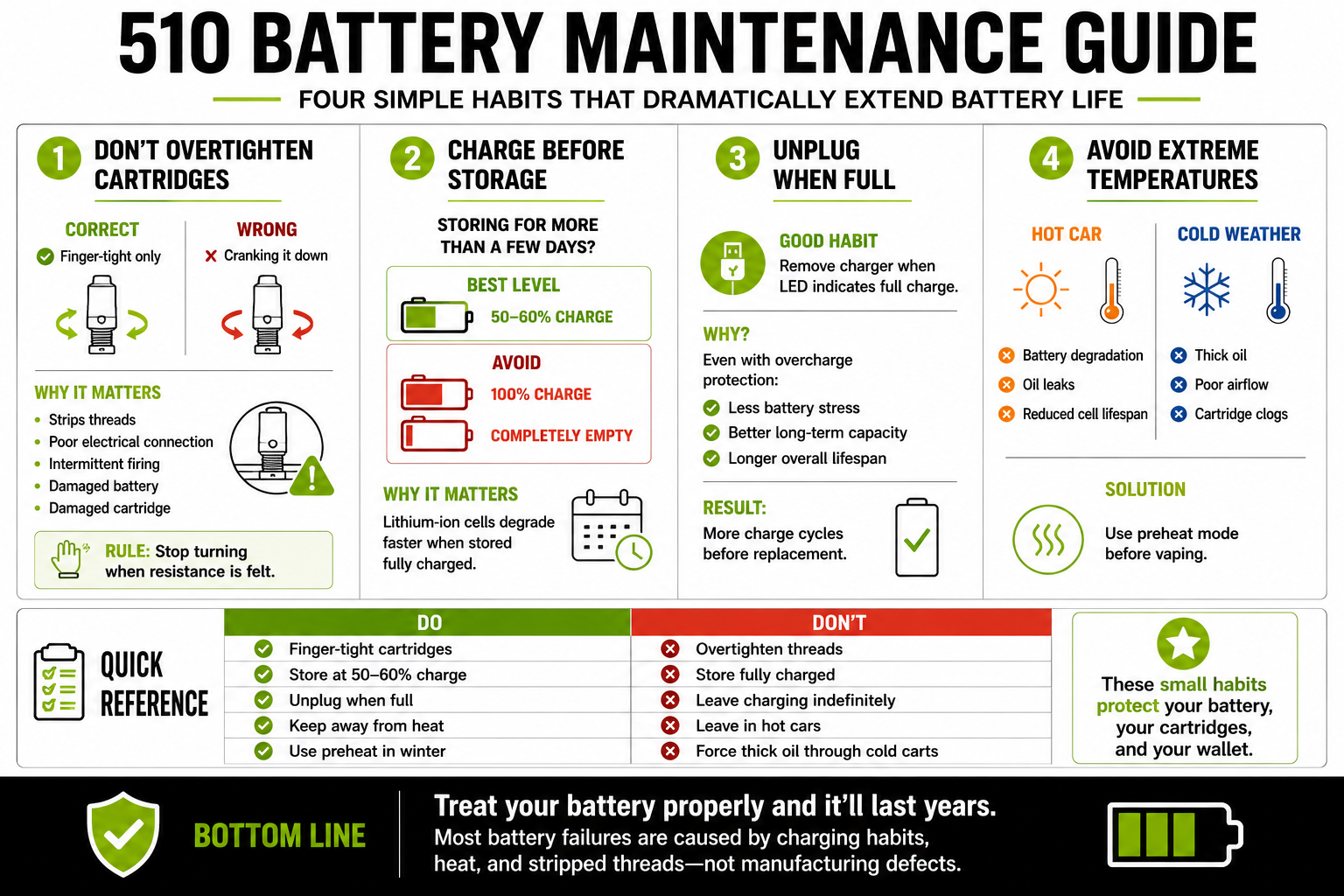
- Do not overtighten cartridges. Finger-tight is enough. Over-tightening strips threads — on the battery, the cart, or both. Once the threads strip, the connection becomes unreliable and neither component is easily salvageable.
- Charge before storage. If you are putting a battery away for more than a few days, charge it to around 50–60% first. Storing at full charge degrades lithium-ion cells faster.
- Unplug when full. Most batteries have overcharge protection, but the habit of unplugging when the LED signals a full charge extends overall battery lifespan meaningfully.
- Avoid extreme temperatures. Leaving a 510 battery in a hot car is a bad idea. Heat degrades the cell and can affect oil viscosity in the cart simultaneously — often causing leaks. Cold weather thickens oil and can cause clogs; preheat mode is your solution there.
Wrapping Up
All 510 thread batteries share the same physical connection standard, but that is where the similarity ends. Voltage output, capacity, activation type, build quality, and price vary enormously — and those differences have a direct impact on how well your cartridges perform and how long they last.
The most important decision you will make is voltage control.
Get a variable voltage battery, learn your oil types, start low, and work up.
Everything else — form factor, capacity, design — is secondary to getting the temperature right for what you are vaping.
Spend $20–40, buy from a reputable brand, and make sure it has preheat if you use thick oils.
That is genuinely the whole playbook.
FAQ: 510 Thread Batteries
Are 510 thread batteries truly universal?
For the vast majority of standard 510-threaded cartridges, yes — the physical connection is compatible across brands. The exception is proprietary pod systems like PAX Era, original Stiiizy pods, and JUUL, which use completely different connections. Standard 510 carts from dispensaries, CBD retailers, and vape shops will all fit a standard 510 battery regardless of brand.
How do I know what voltage to use for my cartridge?
Start low — around 2.4–2.6V — and work up in small increments. If the vapour is thin and weak, increase slightly. If it tastes burnt or harsh, drop back down immediately. Most standard THC distillate carts perform well between 2.8–3.3V. Terpene-rich oils like live resin and rosin are best at 2.5V or lower to avoid scorching the flavour compounds.
What is the difference between button-activated and draw-activated 510 batteries?
Draw-activated (auto-draw) batteries fire automatically when you inhale — no button required. They are simple and beginner-friendly. Button-activated batteries require you to press and hold while inhaling, which gives you more precise control over each hit. For daily use with variable oil types, button-activated is generally the better choice.
What does preheat mode do on a 510 battery?
Preheat runs the battery at low power for 8–15 seconds before your first hit. This gently warms thick oil so it flows properly to the coil, preventing clogs and dramatically improving your first pull of the day — especially in cold conditions or with viscous distillates. If you use any thick oil regularly, this feature is worth having.
How much should I spend on a 510 thread battery?
Want more no-nonsense guides delivered before everyone else sees them? Get into The Atomized newsletter and join us on Facebook — the community has seen every 510 problem you can think of, and then some.